Davenport, Iowa
Dad and I tour downtown Davenport, visiting the Figge Art Museum and learning a bit about the region’s German heritage.
With no drive to start the day, Dad and I had an easy-breezy morning, then cruised into downtown Davenport, Iowa, for a day of sightseeing.
Davenport is the largest city in the Quad Cities region that includes three Illinois cities on the other side of the Mississippi River: Rock Island, Moline, and East Moline. We were staying in Bettendorf, right next to Davenport, and it effectively serves as a fifth Quad city — though I don’t think they’ll ever adopt the more accurate “Penta Cities,” which sounds like the corporate headquarters of a chain of South Florida retirement communities.
A national milestone occurred here in 1856, when the first railroad bridge across the Mississippi was built from Rock Island to Davenport. It crossed the actual island known as Rock Island Arsenal, which has been the site of a major U.S. Army installation since the Civil War. The bridge made this area a hub for lumber, shipping, and manufacturing.
The Figge
We began our explorations at the Figge Art Museum, housed in a dazzling four-story glass-clad building with panels that glow with color at night in a permanent light sculpture called “Evanescent Field.” It was designed by British architect David Chipperfield — whose firm later won the prestigious Pritzker Architecture Prize — and opened in 2005.
The museum traces its collection back to 1925 and now contains more than 4,000 works of art. I continued to appreciate the Midwestern paintings of Grant Wood and others, as I had in Wichita and Cedar Rapids.
Marvin Cone, From Iowa, 1940
Grant Wood, Fall Plowing, 1931
Georges Schreiber, The List, 1941
Edward Melcarth, Manhole, 1959
But there is much more to the museum — works spanning centuries and a variety of media, plus a compelling collection of contemporary works.
Luis Juárez, Saint Teresa of Avila and Her Companions (Fragment), c.1630
Achille Glisenti, The Fortune Teller, 1883
Louis Comfort Tiffany, The River of Life, Frederick C. Denkmann Memorial Window, c.1905
Yuriko Yamaguchi, Fire & Water, 2014
Frantz Zéphirin, L’Apparition d’Aida Wedo, 2001
Mark Messersmith, Malaise of Discontent, 2014
Mia Feuer, Totems of Anthropocene, 2018
Didier William, N’ ap naje ansamn, n’ap vole ansam from Broken Skies: Vertières, 2019
The Figge also gives space to Frank Lloyd Wright, renowned for his architecture but also a prolific designer of interiors and furnishings. He considered the three fields inseparable. The gallery displaying this work at the Figge was organized into mini-rooms to help put objects in their appropriate context.
Davenport
George Davenport
The city is named for George Davenport, an Englishman who at age 19 signed on as a sailor on an American ship that was attacked off the Atlantic coast by pirates in 1803. Wounded, Davenport was brought to Savannah, Georgia. He joined the U.S. Army soon after and was assigned to Fort Armstrong at the Rock Island Arsenal. When he left the service, Davenport became a fur trader and merchant, partnering with the American Fur Company founded by John Jacob Astor.
A Rock Island resident, Davenport advocated for a town to be built on the Iowa side of the Mississippi. The plan was laid out by Antoine LeClaire, Davenport’s friend and business partner. LeClaire was French Canadian and Native American, which allowed him to act as an interpreter and negotiator for treaties between the U.S. government and local tribes. He formally founded the city and named it for his friend, George.
Like Clinton, Davenport grew to be a major lumber-processing center on the Mississippi, bringing sudden and extreme wealth to the city. And like so many other American cities, industries grew — in Davenport, it was locomotives, meat-packing, Caterpillar loaders, movie projectors, and wheels — but many were gone by the 1980s. Though manufacturing remains the largest source of jobs in the city, Davenport has diversified.
Davenport’s SkyBridge — a top attraction that starts near the river and crosses the railroad tracks plus two city blocks — was sadly closed for construction.
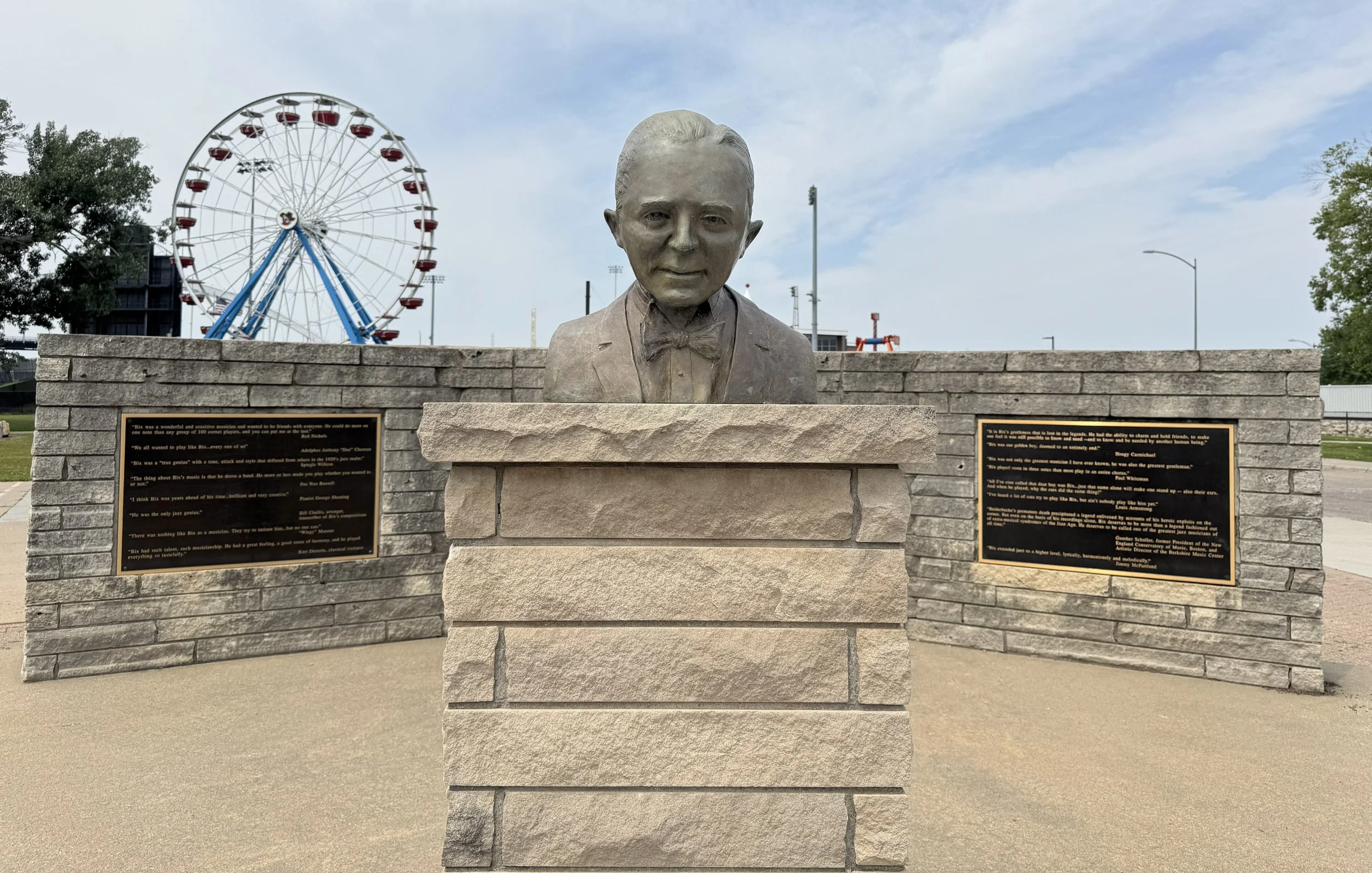
We stopped for a look at the river near an old bandstand and a tribute to Bix Beiderbecke, who played cornet and piano in the 1920s and was one of the most influential jazz musicians of his time. The monument stands just outside left field and the iconic Ferris wheel at Modern Woodmen Park — that night’s venue for Game 18 with the Quad Cities River Bandits.
Front Street Brewery
As a river town on the frontier, with frequent visitors from out of town and loose law enforcement, Davenport sprouted its share of gambling houses and brothels in the late 1800s — so much so that it became to be known in the tabloids as the “Wickedest City in America.” The Bucktown neighborhood was a particular center of that iniquity, with its many drinking establishments and houses of ill repute.
We visited the spiritual descendant of those establishments at Front Street Brewery, a restaurant in a brick building that is more than 100 years old. Front Street has a full brewery down the street, but our minds were on lunch — well, OK, maybe lunch and a Raging River IPA.
I had taken enough time away from my beloved Reuben sandwiches and felt capable of rediscovering the magic of corned beef brisket with Swiss cheese, sauerkraut, and thousand island on toasted rye. It was good to be back.
German American Heritage Center
We finished with a little local history at the German American Heritage Center. It’s housed in a building constructed in 1862 that was originally called the Germania House, built as a gasthaus to provide shelter for newly arrived immigrants.
What caused these immigrants to come en masse to Iowa? In 1848, the king of Denmark controlled three duchies north of Hamburg with significant and growing German populations: Schleswig, Holstein, and Lauenburg. A battle of language and culture stewed within Danish borders until Germans in the region rebelled. The German Confederation backed them, and a four-year war commenced between Denmark and Germany that was won — for the time being — by the Danish.
During the early stages of that conflict, thousands of Germans from the region fled to the United States, many of them to Davenport. These “Forty-Eighters” (marking the 1848 revolution) built a community known as the “free-thinkers” — secular, liberal, democratic. By the 1850s, they comprised 20 percent of the population of Davenport.
The museum celebrates this rich heritage in a rather dense, information-heavy manner, but the many artifacts on display convey the central role the German-American community played in the development and cultural life of the city.
Art and history boxes checked, we headed back to the hotel to rest up before our final Minor League game of the road trip.